Below we outline the types of spots you can get, so you can tell whether you have a mild, moderate or severe problem. They do not all have to be present for you to have acne. Just one type will still mean you have this condition, and there are effective treatments no matter how bad your problem is.
Comedones
These are the starting point of all acne. They begin as very small blockages in the pores. At this stage a blockage is referred to as a microcomedone – the comedone is too small to be seen. Microcomedones can progress to become larger comedones, or they can burst (rupture) internally, causing different types of spots.They burst because of the build-up of pressure and the damage that the inflammatory process does to the wall of the duct.
Whiteheads (closed comedones)
Some people think of whiteheads as a type of pus-like spots, but they are not. As the microcomedone gets larger, because swelling is building up behind the blockage, it becomes visible. If the initial blockage is quite deep in the pore, the opening onto the skin will remain closed; this causes the typical whitish lump that can be seen and felt on the surface.
 Blackheads (open comedones)
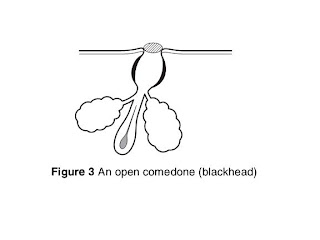
These are clearly visible and very annoying because they look so dark and obvious. The blockage has occurred further up the duct, so its opening is widened and the contents are visible. If you were to dissect your skin, you would see the curly sebaceous gland –which is the escape route for oil – blocked full of a hard, yellow plug. This plug is a mixture of the sebum that has solidified and
the dead lining cells that have been shed. Because these are like skin cells, they contain some of the pigment (melanin) that gives skin its colour. This pigment turns dark when it is exposed to air,so the ‘black’ in ‘blackhead’ is notdirt.
 Inflamed spots
Comedones can stay quite happily in your skin for months, or even years, without changing. If they progress or burst (rupture), though, different kinds of spots result: papules, pustules, nodules and cysts.
Papules
If the comedones start to leak sebum into the surrounding tissue, this produces inflammation and a red spot results. Papules are less than 5mm across and have no pus visible. They could be
called ‘redheads’, as they are otherwise like the whiteheads. If your microcomedones rupture, you will produce papules without going through the whitehead and blackhead stage.
Pustules
A pustule is the typical pus spot or yellowhead. These occur when the bacteria present on the skin and in the duct start to multiply. These bacteria are called Propionibacterium acnes
(usually shortened to P. acnes). They prefer dark places with no air to breed. A blocked pore is ideal and soon there will be lots of bacteria producing more inflammation; this triggers the body’s
own defences as mentioned above, leading to a head of pus on a red swelling.
Nodules and cysts
Comedones, papules and pustules are nasty to look at and caus pain associated with the swelling and inflammation but will clea up without causing much scarring except in people wit
pigmented skin. (This is discussed further in Chapter 6, The physical scars.) The next two types of spot mentioned, howeve – nodules and cysts – can cause real and lasting damage.
Nodules
Nodules are solid spots; they are much bigger than papules and extend deeper into the skin. They are caused when a large comedone has ruptured, releasing lots of inflammatory contents
(white cells and bacteria) into the surrounding skin. More inflammation and pus result, leading to more pain and swelling.The nodule extends deeper into the area that contains the skin’s
structural support. Damage here leads to the scarring.
Cysts
Unlike nodules, cysts are bags of liquid that is a mixture of pus and bacteria. Cysts usually occur only with nodules, often when two or three are close together. They are even more destructive
than nodules to the structure of the skin but, luckily, are quite rare.
Comedones
These are the starting point of all acne. They begin as very small blockages in the pores. At this stage a blockage is referred to as a microcomedone – the comedone is too small to be seen. Microcomedones can progress to become larger comedones, or they can burst (rupture) internally, causing different types of spots.They burst because of the build-up of pressure and the damage that the inflammatory process does to the wall of the duct.
Whiteheads (closed comedones)
Some people think of whiteheads as a type of pus-like spots, but they are not. As the microcomedone gets larger, because swelling is building up behind the blockage, it becomes visible. If the initial blockage is quite deep in the pore, the opening onto the skin will remain closed; this causes the typical whitish lump that can be seen and felt on the surface.
 Blackheads (open comedones)
These are clearly visible and very annoying because they look so dark and obvious. The blockage has occurred further up the duct, so its opening is widened and the contents are visible. If you were to dissect your skin, you would see the curly sebaceous gland –which is the escape route for oil – blocked full of a hard, yellow plug. This plug is a mixture of the sebum that has solidified and
the dead lining cells that have been shed. Because these are like skin cells, they contain some of the pigment (melanin) that gives skin its colour. This pigment turns dark when it is exposed to air,so the ‘black’ in ‘blackhead’ is notdirt.
 Inflamed spots
Comedones can stay quite happily in your skin for months, or even years, without changing. If they progress or burst (rupture), though, different kinds of spots result: papules, pustules, nodules and cysts.
Papules
If the comedones start to leak sebum into the surrounding tissue, this produces inflammation and a red spot results. Papules are less than 5mm across and have no pus visible. They could be
called ‘redheads’, as they are otherwise like the whiteheads. If your microcomedones rupture, you will produce papules without going through the whitehead and blackhead stage.
Pustules
A pustule is the typical pus spot or yellowhead. These occur when the bacteria present on the skin and in the duct start to multiply. These bacteria are called Propionibacterium acnes
(usually shortened to P. acnes). They prefer dark places with no air to breed. A blocked pore is ideal and soon there will be lots of bacteria producing more inflammation; this triggers the body’s
own defences as mentioned above, leading to a head of pus on a red swelling.
Nodules and cysts
Comedones, papules and pustules are nasty to look at and caus pain associated with the swelling and inflammation but will clea up without causing much scarring except in people wit
pigmented skin. (This is discussed further in Chapter 6, The physical scars.) The next two types of spot mentioned, howeve – nodules and cysts – can cause real and lasting damage.
Nodules
Nodules are solid spots; they are much bigger than papules and extend deeper into the skin. They are caused when a large comedone has ruptured, releasing lots of inflammatory contents
(white cells and bacteria) into the surrounding skin. More inflammation and pus result, leading to more pain and swelling.The nodule extends deeper into the area that contains the skin’s
structural support. Damage here leads to the scarring.
Cysts
Unlike nodules, cysts are bags of liquid that is a mixture of pus and bacteria. Cysts usually occur only with nodules, often when two or three are close together. They are even more destructive
than nodules to the structure of the skin but, luckily, are quite rare.
